Quick Answer
AI transformation is a problem of governance, not a problem of models. Almost every company can now buy a strong AI system. Very few can say who owns it, what data it may touch, who checks its output, and who turns it off. Those four answers decide if a pilot becomes real work or dies quietly. AI transformation is a problem of governance long before it is a problem of budget. Fix the rules first, and the tools start to pay.
Key Takeaways
- AI transformation is a problem of governance because the hard part is decision rights, not compute power.
- MIT's 2025 research found that about 5% of AI pilot programs achieve rapid revenue acceleration, while the vast majority stall with little or no measurable impact on profit and loss.
- Six gaps cause most failures: no owner, shadow AI, unclear data rules, no human check, no measurement, and no off switch.
- Governance is not a legal side project. It is the operating system of your AI program.
- Three public frameworks already do the heavy lifting: the EU AI Act, the NIST AI Risk Management Framework, and ISO/IEC 42001.
- Small teams can build working AI governance in about 90 days with a one-page policy and a simple risk tier.
Definition: What Does This Phrase Mean?
AI governance is the set of rules, roles, and checks that decide how an organization builds, buys, uses, and retires AI systems.
When people say AI transformation is a problem of governance, they mean the blocker is not the technology. The blocker is the human system around it. Who approves a use case? Who owns the risk? Who reads the output before a customer sees it? Who pulls the plug when it goes wrong?
Why AI Transformation Is a Problem of Governance
AI transformation is a problem of governance for one simple reason. The technical barrier fell, and the human barrier did not.
Ten years ago, the hard part was building a model. You needed rare skills, a big budget, and months of work.
That changed. Today a mid-size firm can rent a frontier model with a credit card. The technology gap between a bank and a five-person startup has almost closed.
So the bottleneck moved. It moved from the lab to the org chart.
This is why AI transformation is a problem of governance. Two firms can use the exact same model and get opposite results. One ships a tool that saves 200 hours a month. The other runs a pilot for a year and quietly shuts it down.
The difference is rarely the model. It is usually the rules. AI transformation is a problem of governance in the most literal sense, because governance is just the rules written down.
MIT's NANDA team studied this directly. Their report reviewed 300 public AI deployments, 52 executive interviews, and surveys of 153 leaders, and found that 95% of pilots delivered no measurable profit impact. The authors were clear about the cause. They pointed to flawed enterprise integration and a learning gap, not to weak model quality or to regulation.
Read that again. The models worked. The organizations did not. That single finding is the strongest evidence that AI transformation is a problem of governance.
AI Transformation Is a Problem of Governance Because the Question Changed
Most leaders still ask the old question.
- Old question: Which AI tool should we buy?
- New question: Who is allowed to decide, and who carries the risk?
The old question has a hundred good answers. The new question has almost none inside most companies. That gap is the whole story.
6 Reasons AI Transformation Is a Problem of Governance
Here are the six gaps that show up again and again. Each one is a governance gap, not a technical one. Together they explain why AI transformation is a problem of governance in almost every company that stalls.
Gap 1: Nobody Owns the Decision
Ask a company who owns its AI program. You often hear four answers in one room. IT says security owns it. Security says legal owns it. Legal says the business owns it. The business says IT owns it.
When four teams own a thing, nobody owns it.
Projects then stall in review loops. A team builds a good tool, then waits eleven weeks for an approval that no single person is allowed to give.
Fix: Name one accountable owner per AI use case. Write their name down. Give them a budget and a deadline. Ownership is the first place AI transformation is a problem of governance, and it is also the cheapest to fix.
Gap 2: Shadow AI Runs the Real Business
While the official pilot crawls, staff just use their own tools.
MIT found this pattern everywhere. Only around 40% of companies had official model subscriptions, yet about 90% of the workers surveyed used personal AI tools for job tasks every day.
That is not laziness. It is people routing around a slow process. But it creates real exposure. Company data leaves through a browser tab, and no log records it.
Samsung learned this in 2023. Engineers pasted internal source code into a public chatbot to debug it. The company banned the tools on internal devices soon after.
Banning rarely works for long. People need the speed. So give them a sanctioned path that is faster than the shadow one.
Fix: Approve two or three tools. Make signup take five minutes. Then log usage. Shadow tools are proof that AI transformation is a problem of governance, because the demand was there and the process was not.
Gap 3: No Clear Data Rules
"Can I put customer data in this?" is the most common question in any AI rollout. Most staff cannot answer it. Neither can their manager.
So they guess. Some guess too cautiously and never ship. Others guess too freely and create a breach.
You do not need a 90-page data policy. You need a simple traffic light.
| Data Type | Public Tool | Approved Enterprise Tool | Internal Model Only |
|---|---|---|---|
| Marketing copy, public web content | Yes | Yes | Yes |
| Internal docs, drafts, meeting notes | No | Yes | Yes |
| Customer names, emails, order history | No | Yes, with a signed data agreement | Yes |
| Health, finance, ID, or biometric records | No | No | Yes, with legal sign-off |
| Source code and trade secrets | No | Yes, if training is turned off | Yes |
Print that. Stick it in the wiki. You just solved a third of your risk. A single page like this shows how much of the work is policy, which is why AI transformation is a problem of governance rather than engineering.
Gap 4: No Human Check Where It Matters
Not every AI output needs review. A first draft of a blog post does not. A denied insurance claim does.
The gap appears when a company applies the same rule to both, or applies no rule at all. Blanket review kills speed. Zero review invites harm.
Tier the check instead:
- Tier 1, internal only. Drafts, summaries, brainstorms. No review needed.
- Tier 2, customer facing. Emails, chat replies, published copy. Spot check a sample each week.
- Tier 3, consequential. Anything touching money, hiring, credit, health, or legal rights. A named human signs off every time.
This is where AI transformation is a problem of governance stops being an abstract idea and turns into a lawsuit. The next section shows exactly that.
Gap 5: Nobody Measures the Outcome
Many teams track the wrong thing. They report seats used, prompts sent, and logins. Those numbers rise even when value stays flat.
MIT saw this split clearly. Adoption ran high while transformation stayed low, and only two of nine major sectors showed material business change.
If you cannot name the hours saved, the errors cut, or the revenue moved, you do not have a project. You have a subscription. Measurement is another reminder that AI transformation is a problem of governance, since nobody had to define success before the money was spent.
Gap 6: No Off Switch
Ask any team this question: if this model starts giving bad answers on a Friday night, who can turn it off, and how long does it take?
Silence is common. That silence is the gap.
A model is not a static piece of software. Its behavior shifts when the vendor updates it, when your data changes, or when users find new ways to prompt it. You need a review date and a rollback plan on day one.
Best Practice Box: Give every AI system three things before launch. An owner's name. A review date. A documented way to shut it down in under one hour. Miss any of the three and AI transformation is a problem of governance waiting to surface.
Real Example: The Air Canada Chatbot Ruling
Here is what a governance gap costs in the real world.
In November 2022, a passenger named Jake Moffatt visited Air Canada's website after a death in his family. The site's chatbot told him he could book a flight and apply for a bereavement discount within 90 days.
That was wrong. The airline's actual policy did not allow a claim after booking.
Moffatt followed the chatbot's advice, then asked for the refund. Air Canada refused. The case went to British Columbia's Civil Resolution Tribunal.
In February 2024, the tribunal ruled against the airline and awarded Moffatt damages plus fees. Air Canada had argued that the chatbot was a separate entity responsible for its own words. The tribunal rejected that idea outright. The company published the information. The company owned the result.
Look at what actually failed here.
- The model worked fine. It produced fluent, confident text.
- No owner had been named for chatbot content accuracy.
- No process synced the bot's answers with the real policy page.
- No human reviewed a customer-facing answer about money.
- No monitoring caught the error before a customer relied on it.
Every single failure was a governance failure. The dollar amount was small. The precedent was not. A company owns what its AI says, and courts now treat that as settled.
This is the clearest proof that AI transformation is a problem of governance. Air Canada did not need a better model. It needed a person whose job was to check the bot.
A Bigger Version of the Same Mistake
The Dutch childcare benefits scandal shows the same failure at national scale.
Between 2013 and 2019, the Dutch tax authority used a risk-scoring system to flag possible benefit fraud. The system treated markers like dual nationality as risk signals. Around 26,000 families were wrongly accused. Many were forced to repay tens of thousands of euros they did not owe. Some lost their homes. Some had children removed.
The Dutch government resigned over it in January 2021.
Nobody had asked the governance questions. What data trains this? Who can appeal a score? Who audits the outcome by group? Who reviews a decision that ruins a family?
At national scale or team scale, AI transformation is a problem of governance with the same four unanswered questions.
Technology-First vs Governance-First: A Comparison
The table below shows in practice why AI transformation is a problem of governance across the whole project lifecycle.
| Factor | Technology-First Approach | Governance-First Approach |
|---|---|---|
| First question asked | Which tool do we buy? | Which decision are we changing, and who owns it? |
| Pilot selection | Whatever demos well | Whatever has a measurable cost today |
| Data rules | Written after an incident | Written before the first prompt |
| Human review | Applied evenly or not at all | Tiered by how much harm an error causes |
| Success metric | Seats and prompt volume | Hours saved, errors cut, revenue moved |
| Typical outcome | Impressive demo, dead pilot | Slower start, compounding value |
| Audit readiness | Panic when regulators call | Documentation already exists |
The governance-first path feels slower in month one. It is much faster by month six, because you are not rebuilding after every surprise.
Where AI Governance Fits in a Wider AI Strategy
Governance is not a wall. It is the road that lets you drive faster without crashing. Once you accept that AI transformation is a problem of governance, every tool decision gets easier.
It touches every part of an AI program. If you are choosing between vendors, our guide to the top AI consulting firms explains what to expect from an outside partner and which claims to check before you sign.
Governance also shapes hiring. The role that ties policy to product is growing fast, and our breakdown of AI product manager jobs shows what those teams actually own day to day.
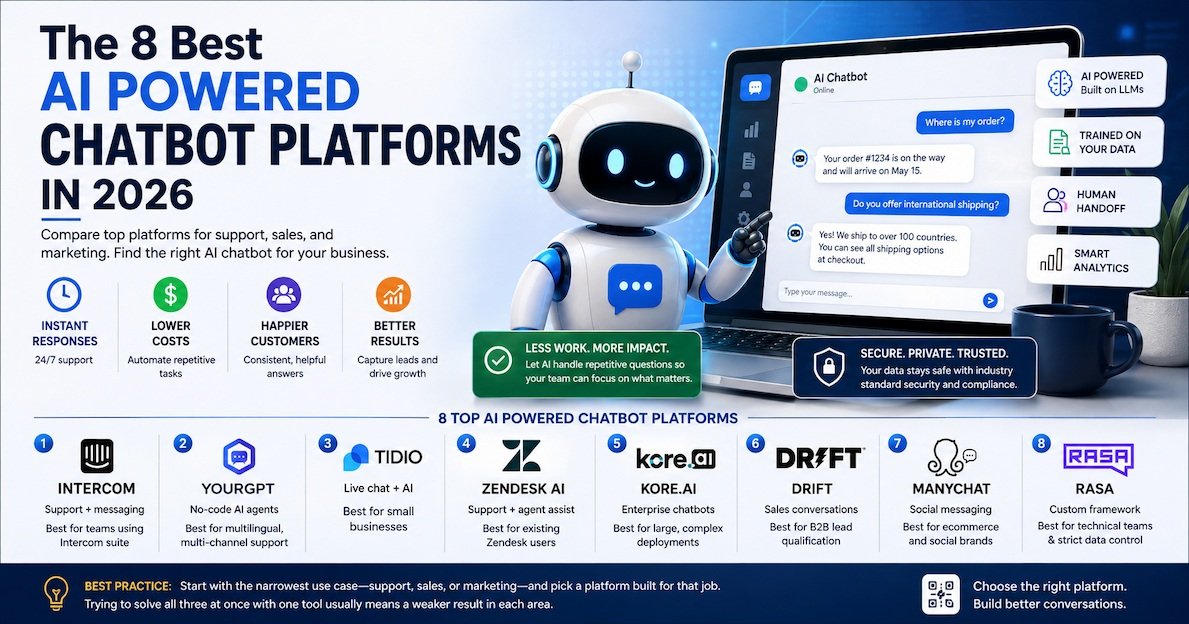
Customer-facing systems carry the most risk, which is why our review of AI-powered chatbot platforms covers audit logs and escalation paths, not just response quality. The Air Canada case sits squarely in that category.
Marketing teams face the same questions from a different angle. If your team creates ads at scale, see our list of the best AI tools for Facebook and Instagram ad creatives, where disclosure rules and brand safety checks now matter as much as output speed.
Data-heavy functions need the tightest rules. Our guide to sales intelligence tools for B2B contact data walks through consent and sourcing questions that any buyer should ask first.
Media production raises its own consent issues, and our roundup of top AI avatar tools for multilingual voiceovers covers voice rights and disclosure duties in plain terms.
Startups often assume governance is a big-company problem. It is not. Our list of top SaaS tools for startups shows how early access controls save painful cleanup later.
One more warning. Not every AI product you read about is real. Our investigation into the Abraham Quiros Villalba AI tool shows how unverifiable tools spread online. Vendor verification is itself a governance control.
The Three Frameworks You Do Not Need to Invent
You do not have to write AI governance from scratch. Three public frameworks already exist, and they overlap heavily. Each one starts from the same premise, which is that AI transformation is a problem of governance long before it is a problem of engineering.
| Framework | Type | Who It Binds | Best Used For |
|---|---|---|---|
| EU AI Act | Law | Anyone placing AI on the EU market or whose AI output is used in the EU | Risk tiering, transparency duties, high-risk system controls |
| NIST AI Risk Management Framework | Voluntary framework | Nobody, by law | Structuring your program around Govern, Map, Measure, Manage |
| ISO/IEC 42001 | Certifiable standard | Organizations that choose it | Proving a management system to customers and auditors |
What Changed in the EU AI Act This Year
The EU timeline moved recently, and many compliance calendars are now out of date.
The Digital Omnibus on AI, Regulation (EU) 2026/1744, was published in the Official Journal on 24 July 2026 and entered into force on 27 July 2026. It changed several deadlines.
High-risk obligations for stand-alone Annex III systems now apply from 2 December 2027, and for AI embedded in regulated products under Annex I from 2 August 2028.
Do not read that as a pause. The Article 50 transparency obligations were not deferred and still apply from 2 August 2026. That means telling people when they are talking to a bot and labeling synthetic content. Watermarking duties under Article 50(2) reach legacy systems on 2 December 2026, and new prohibited practices apply from that date too.
The Omnibus also added a prohibition on AI systems used to create non-consensual intimate imagery and child sexual abuse material.
The lesson holds. Rules keep moving, so build a program that can absorb change instead of chasing single dates. Shifting deadlines are yet another sign that AI transformation is a problem of governance, because only a governed program can adapt without a rebuild.
Best Practice Box: Map your AI systems to risk tiers now, even if your deadline moved. The registration and documentation work takes months, and the extension only helps teams who start early.
9 Steps to Fix AI Transformation as a Problem of Governance
You can do this without a consultant and without a committee of twenty people.
- List every AI system in use. Include shadow tools. Ask teams directly and promise no punishment for honest answers.
- Sort each one into three risk tiers. Low risk means internal drafts. Medium risk means anything a customer sees. High risk means anything affecting money, health, employment, or legal rights.
- Name one owner per system. A real person, not a department. Put the name in a shared sheet.
- Write the data traffic light. One page. Use the table above as a starting point.
- Set human review rules by tier. Low risk needs no review. Medium risk needs spot checks. High risk needs a named human who signs off every time.
- Turn on logging. You cannot govern what you cannot see. Capture prompts, outputs, and user IDs for medium and high tiers.
- Pick one metric per system. Hours saved, tickets deflected, error rate cut. One number, reviewed monthly.
- Write the shutdown plan. Who can disable it, how, and how fast. Test it once.
- Book a quarterly review. Recheck the risk tier, the metric, and the vendor's changes.
That is the whole program. Nine steps. Most teams finish it in a quarter. None of them needs new technology, which proves the point that AI transformation is a problem of governance.
Who Should Own AI Governance?
The most common mistake is parking governance inside legal alone. Legal knows the rules, but legal does not run the workflow.
The most effective setup uses a small group with clear splits.
| Role | Owns | Does Not Own |
|---|---|---|
| Executive sponsor | Budget, risk appetite, final escalation | Daily approvals |
| AI lead or product owner | Use case selection, metrics, rollout | Legal interpretation |
| Legal and compliance | Regulatory mapping, contracts, disclosures | Tool choice |
| Security and data | Access control, logging, data classification | Business value calls |
| Business unit owner | Human review, quality checks, staff training | Infrastructure |
Five roles. One meeting a month. That beats a twenty-person steering committee that meets twice a year. Clear splits like these are how AI transformation is a problem of governance gets solved in practice.
Key Takeaway: Governance fails when it is a committee. It works when it is a short list of named people with clear decisions.
9 Signs AI Transformation Is a Problem of Governance at Your Company
Check your own organization against this list. Three or more means you have work to do.
- Pilots run for more than six months without a production decision.
- Nobody can produce a list of AI tools in use across the company.
- Staff use personal accounts for work tasks.
- Two teams built the same tool without knowing about each other.
- Your AI success metrics are all usage numbers.
- No one has ever turned an AI system off.
- Legal reviews arrive after the build, not before.
- A vendor changed a model version and nobody noticed.
- Your incident plan does not mention AI at all.
Each item is fixable in weeks. None of them requires new technology. That is the clearest test of whether AI transformation is a problem of governance in your business.
Why Governance Speeds Things Up
Many leaders resist this because governance sounds like delay. In practice, the opposite happens.
Clear rules remove the biggest source of delay in AI projects, which is uncertainty. When a team knows the data rules, the risk tier, and the approver's name, they stop waiting. They just build.
Compare two teams. Team A has no policy. Every new idea triggers a fresh debate about data and liability, and each debate takes four weeks. Team B has a one-page policy. Low-risk ideas ship the same week.
Team B is not more reckless. It is more governed. Speed and safety are the same project once you accept that AI transformation is a problem of governance.
This is the practical reason AI transformation is a problem of governance. Governance is not friction added to speed. It is the thing that makes speed safe enough to sustain.
Frequently Asked Questions
It means the main barrier is organizational, not technical. Companies can access strong models easily, but struggle to define ownership, data rules, review steps, and shutdown authority for those systems.
No. Small teams face the same risks with fewer safety nets. A one-page policy, a named owner per tool, and basic logging cover most needs for a startup.
Most small and mid-size organizations complete a working program in about 90 days. The inventory takes two weeks, the policy takes one, and the rest is rollout and training.
No, it usually speeds it up. Clear rules remove repeated debates about data and liability, so teams ship low-risk projects faster instead of waiting for one-off approvals.
The organization deploying it. The Air Canada tribunal ruling in 2024 rejected the idea that a chatbot is a separate entity responsible for its own statements to customers.
Ethics asks what an organization should do. Governance builds the roles, rules, and checks that make those answers happen consistently across real systems and daily work.
Start with the NIST AI Risk Management Framework for structure. Add EU AI Act mapping if you serve European users, and ISO/IEC 42001 if customers require certification.
Partly. High-risk obligations for Annex III systems shifted to December 2027, but transparency duties under Article 50 still applied from 2 August 2026 without any delay.
Shadow AI is unapproved tool use by staff. It matters because company data leaves without logging, which creates breach risk and hides real usage from leadership entirely.
Track approved tool coverage, time from idea to launch, incident count, and business value per system. Rising coverage with falling launch time signals a healthy program.
Final Word
The AI market sells transformation as a purchase. Buy the platform, get the results.
That is not how it works. The tools are already good. The bottleneck sits in your decision rights, your data rules, and your review steps.
AI transformation is a problem of governance. The companies pulling ahead did not find a secret model. They answered four boring questions before they started, and they wrote the answers down.
Who owns it. What data it touches. Who checks it. Who turns it off.
Answer those four, and AI transformation is a problem of governance you have already solved. Start there.