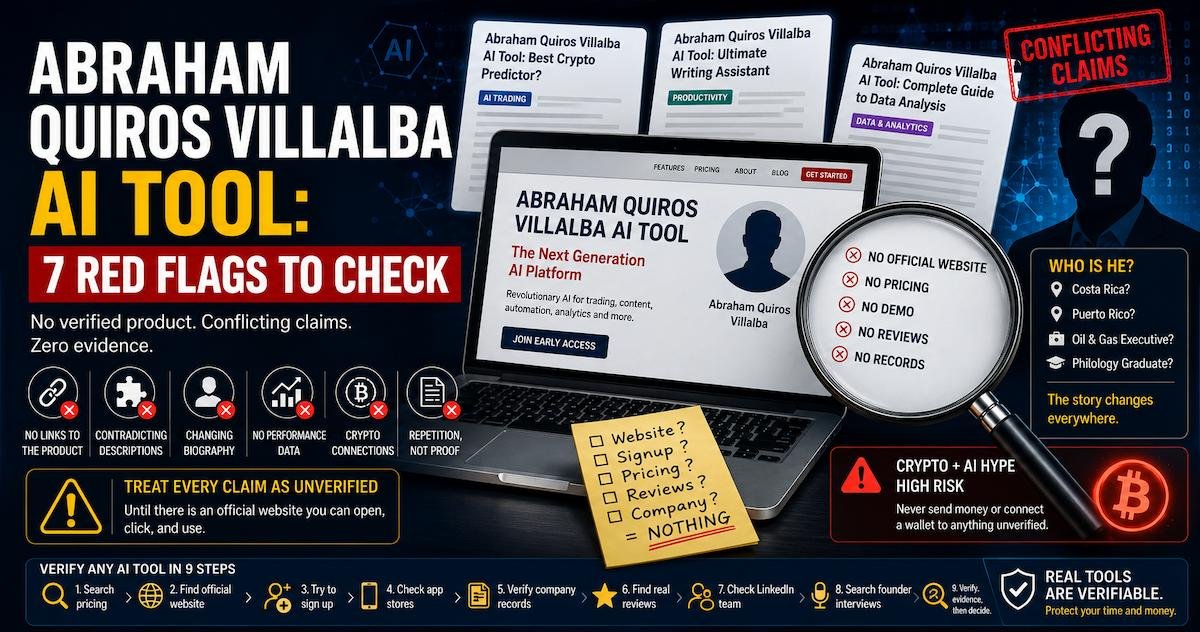
Quick AnswerThe Abraham Quiros Villalba AI tool has no verified public product. As of August 2026, we found no official website, no pricing page, no app listing, no company record, no demo, and no confirmed user of any tool by this name. Dozens of blogs describe it, but they contradict each other. Some call it a writing assistant. Others call it a crypto trading predictor. A few call it a data analysis suite. Until a real product page exists that you can open and click, treat every claim about this tool as unconfirmed.
If you searched for the Abraham Quiros Villalba AI tool, you probably read two or three articles before this one. You may have noticed something odd. They all sound confident. They all describe features. But none of them link to the actual product.
That is not an accident. It is the whole story.
We run a hand-checked directory. Every tool listed on this site was opened, signed into, and clicked through by a person before it went live. So when a tool name starts trending, we do the same thing we always do. We try to use it.
We could not use this one. Here is exactly what we found, and more importantly, how you can run the same check yourself on any AI tool.
Key Takeaways
- No verifiable product exists under the name Abraham Quiros Villalba AI tool as of August 2026.
- Articles about it contradict each other on what the tool even does.
- Biographical details about the person also conflict across sites.
- A real writer by this name appears to exist and does legitimate work unrelated to AI software.
- There is no evidence that person wrote, approved, or profits from these articles.
- Some content connects the name to crypto investing, which raises the risk level sharply.
- The safest response is simple. Do not send money or connect a wallet to anything using this name.
What Is the Abraham Quiros Villalba AI Tool Supposed to Be?
This is where the story falls apart fastest.
We read a large number of pages ranking for this term. They do not agree on the basic question of what the product is.
Definition
Abraham Quiros Villalba AI tool is a search term, not a confirmed product. It refers to an artificial intelligence platform that many blog posts claim exists, attributed to a person of that name. The descriptions vary widely between sources, and no primary source, official website, or company filing confirms the product's existence.
Here is what different sites claim, side by side.
| Source Type | What They Say It Does | Evidence Given |
|---|---|---|
| AI blog network posts | Crypto and stock market prediction platform | None |
| Generic tool review sites | Content writing and productivity assistant | None |
| "Complete guide" style posts | Data analysis with NLP and predictive analytics | None |
| Name-branded domains | Broad automation and digital innovation platform | None |
| Crypto exchange education desks | Warn the name is unverified | Cite lack of records |
Notice the pattern. The four confident answers give no evidence. The one cautious answer explains its reasoning.
A real product does not have four different purposes. Notion is a workspace. Midjourney makes images. Claude is an assistant. You can describe each in one sentence and everyone agrees on that sentence.
When five sources describe a tool five different ways, they are not describing a tool. They are describing a keyword.
What We Verified About the Abraham Quiros Villalba AI Tool
We ran the same checks we run for every submission to our directory. You can read our full review guidelines to see the standard we hold listings to.
Here is the result.
| Verification Check | Result |
|---|---|
| Official product website | Not found |
| Pricing or plans page | Not found |
| Free trial or demo | Not found |
| App Store or Google Play listing | Not found |
| Company registration record | Not found |
| GitHub or technical documentation | Not found |
| Named team members | Not found |
| Independent press coverage | Not found |
| Verified user reviews on G2, Capterra, Trustpilot | Not found |
| Working login page | Not found |
Ten checks. Ten blanks.
To be fair and clear, a blank is not proof of fraud. Early products are sometimes quiet. Founders sometimes build in private before launch.
But there is a difference between a quiet product and a loud absence. A genuinely early-stage tool usually has one thing at minimum: a landing page with an email signup. This has dozens of articles and zero landing pages.
That inversion is the signal.
7 Red Flags Worth Knowing
These apply to the Abraham Quiros Villalba AI tool specifically, and to any trending tool name you come across.
1. Every article describes it, none link to it
Real tools get reviewed with screenshots, sign-up walkthroughs, and a link to try it. Look at any article ranking for this term. Count the links to an actual product. The answer is usually zero.
2. The descriptions contradict each other
A writing assistant and a crypto predictor are not the same category. They are not even adjacent. Contradiction at this level means the writers had a keyword, not a login.
3. The biography changes between sources
Some pages say Costa Rica. Others say Puerto Rico. Some describe an oil and gas executive turned renewable energy pioneer. Others describe a philology graduate who writes about government benefits in English and Spanish.
Those are not the same career. One of them is probably closer to true. Most of them cannot be.
4. The claims escalate as you read more articles
Early posts describe general AI features. Later posts add early Bitcoin adoption, institutional-grade market intelligence, and ethical prediction models. Each writer copies the last and adds one impressive detail.
This is how a rumour grows. It is not how a product spec sheet grows.
5. There is no performance data
Several sources admit this directly. No published accuracy figures. No user outcomes. No audited returns. For a tool supposedly built to predict markets, that absence is the entire ballgame.
6. Crypto keeps appearing next to the name
Multiple pages tie the tool to cryptocurrency trading, and some crypto exchange education teams have published guidance treating claims around this name as unverified. When a name appears in token promotion contexts without a verifiable person behind it, caution is not optional.
7. Repetition is being mistaken for confirmation
This is the deepest problem. You read the same claim on eight sites and it starts to feel true. But eight copies of one unverified claim is still one unverified claim.
Best Practice Box
Count sources, not pages. Before you trust a claim about any tool, ask where the first version of that claim came from. If every article traces back to other articles, and none trace back to a product, a filing, an interview, or a company record, you have found a loop with nothing at the centre. A hundred pages citing each other is weaker evidence than one working login screen.
A Real Example: Following the Loop
We tried to trace one specific claim to its origin. The claim was that the platform uses "ethical prediction models."
Here is what happened.
- We found it on a crypto question-and-answer page.
- That page gave no source.
- We found nearly identical wording on an AI tools blog.
- That blog gave no source either.
- We found it again on a name-branded domain built entirely around this one keyword.
- Still no source.
- We looked for any primary document. A whitepaper, a patent, a press release, a conference talk, a LinkedIn post. Nothing.
Seven steps in, we were back where we started. The claim exists. Its origin does not.
Compare that to a real tool. Search any product in our browse directory and within two clicks you reach a homepage, a pricing page, and a signup form. That is what a two-minute verification looks like when the thing is real.
Who Is Abraham Quiros Villalba?
This part deserves care, because a real person may be involved and fairness matters.
Based on the more measured sources, a writer named Abraham Quiros Villalba appears to exist and appears to do legitimate work. The most consistent description is of a bilingual content writer with a philology background who explains government benefits, Social Security topics, and public programs in clear English and Spanish.
That is honest, useful work. It has nothing to do with AI software or crypto trading.
Here is what matters most:
There is no evidence this person wrote these AI tool articles, endorsed them, or benefits from them.
Names get attached to content without permission all the time. A name that ranks becomes a target. Content farms notice a term getting searches, then produce dozens of articles around it to capture traffic. The person named often has no idea it is happening.
So the responsible framing is this. The claims are unverified. The person is not the story. The content pattern is.
Why This Keyword Exists at All
Understanding this makes you harder to fool in future.
Definition Box
Entity farming is an SEO tactic where publishers build large volumes of content around a person's name or a made-up product name to capture search traffic. The goal is ad revenue or affiliate clicks, not accuracy. The content often reads well and sounds authoritative, because sounding authoritative is cheaper than being accurate.
The mechanics are straightforward.
- A name starts getting a few hundred searches a month.
- Keyword tools flag it as low competition.
- Writers produce articles fast, often with AI assistance.
- Each new article cites the previous ones.
- Search engines see volume and consistency, and rank the pages.
- More rankings create more searches, and the loop feeds itself.
Nothing in that process requires the subject to exist.
This is why we built this site around human checks rather than automated scraping. A crawler cannot tell the difference between a product page and a page about a product. A person can, in about thirty seconds.
How to Verify Any AI Tool in 9 Steps
Use this on the Abraham Quiros Villalba AI tool, or on anything else that starts trending.
- Search the exact tool name plus the word "pricing." Real products have a pricing page. This is the fastest single test.
- Look for a domain owned by the product itself. Not a blog about it. The product's own home.
- Try to sign up. If there is no signup, there is no product yet.
- Check an app store if it claims a mobile app.
- Search for the company name in your country's business register.
- Look on G2, Capterra, or Trustpilot for reviews written by named users.
- Check LinkedIn for employees who list the company.
- Search for the founder plus "interview" or "podcast." Real founders talk publicly.
- Reverse image search any screenshots in the articles. Stock photos and reused dashboards are common.
If steps one through three all fail, stop. You do not need steps four through nine.
Quick Verification Checklist
- Product has its own website, not just blog coverage
- Pricing is published somewhere
- You can create an account or join a real waitlist
- At least one named human is attached to the company
- At least one independent review exists from a named user
- Claims about results include actual numbers and a method
- Nothing asks for a wallet connection or upfront payment before you see the product
Extra Care If Money Is Involved
Some content around this keyword connects the tool to investing, crypto, and market predictions. That changes the risk from wasted time to lost money.
Regulators have already flagged this exact pattern. The SEC, NASAA, and FINRA jointly issued an investor alert about investment fraud involving the claimed use of artificial intelligence. It explains how bad actors use AI hype to build credibility fast, and what warning signs to look for. You can read it directly at the SEC investor alert on AI and investment fraud (dofollow).
The core rules from that guidance apply here perfectly:
- Be wary of any claim that AI can guarantee returns.
- Check whether the platform and the people are registered.
- Confirm sources independently rather than trusting repetition.
- Never share seed phrases, private keys, passwords, or verification codes.
- Treat unsolicited private messages offering early access as a warning sign.
If anything using this name ever asks you to connect a wallet, send funds, or buy a token, stop immediately and verify through official channels first.
What to Use Instead
If you arrived here wanting an actual AI tool for the jobs these articles describe, the good news is that verified options exist for every one of them.
| If You Wanted | Look For | Where to Start |
|---|---|---|
| Writing and content help | Established AI writing assistants | AI Writing category |
| Data analysis and insights | Analytics tools with published docs | Data & Analytics category |
| Task automation | Workflow and agent platforms | Agents & Automation category |
| Market research | Registered, licensed financial platforms | A regulated broker, not a blog |
Every listing in those categories was opened and tried by a person first. You can see the full set on our categories page, and if you build AI tools yourself, you can submit one for review.
FAQ
Is the Abraham Quiros Villalba AI tool real? No verified product exists. We found no official website, pricing page, app listing, demo, or confirmed user as of August 2026, despite many articles describing it.
What does the Abraham Quiros Villalba AI tool do? Sources disagree completely. Some describe content writing, others crypto prediction, others data analysis. That contradiction is strong evidence no single real product exists.
Can I download or sign up for the Abraham Quiros Villalba AI tool? We found no working signup, login, download, or waitlist. If a page offers one, verify it carefully before entering any personal or payment details.
Is Abraham Quiros Villalba a real person? A bilingual writer by this name appears to exist and covers government benefits topics. Details vary across sites, and much online biographical content is unverified.
Did he create these AI tool articles? There is no evidence he wrote, approved, or profits from them. Names are frequently used in content farming without the person's knowledge or consent.
Why do so many websites write about this tool? The keyword gets searches and has low competition. Publishers create articles to capture traffic, citing each other rather than any original verified source.
Is it a scam? We found no product, so there is nothing to label. The risk appears when content ties the name to crypto or asks for money or wallet access.
Why do the articles all sound so confident? Confidence is cheap to write. Verification takes work. Content produced quickly for traffic often reads more certain than carefully researched reporting does.
How can I check if any AI tool is real? Search the tool name plus "pricing," look for its own domain, and try to sign up. If all three fail, stop there.
Should I invest based on any AI tool claims? No. Regulators warn that fraudsters exploit AI hype. Verify registration through official channels and treat guaranteed return claims as a clear warning sign.
Will this change if the tool launches later? Possibly. If a verifiable product with a real website and working signup appears, we will test it and update this page accordingly.
Final Thoughts
The honest answer about the Abraham Quiros Villalba AI tool is short. There is nothing to review yet.
That is not an exciting conclusion. It will not match the confident articles ranking around it. But it is what the evidence supports, and you deserve the evidence rather than a well-written guess.
The wider lesson is worth more than this one keyword. AI moved fast enough that the internet filled with articles about tools nobody has used. Some of those tools are real and simply early. Some do not exist at all. The only reliable way to tell them apart is to open the thing and click it.
That takes two minutes. It is the same two minutes we spend on every listing here, and it is the reason we can tell you honestly when something does not check out.