Quick Answer
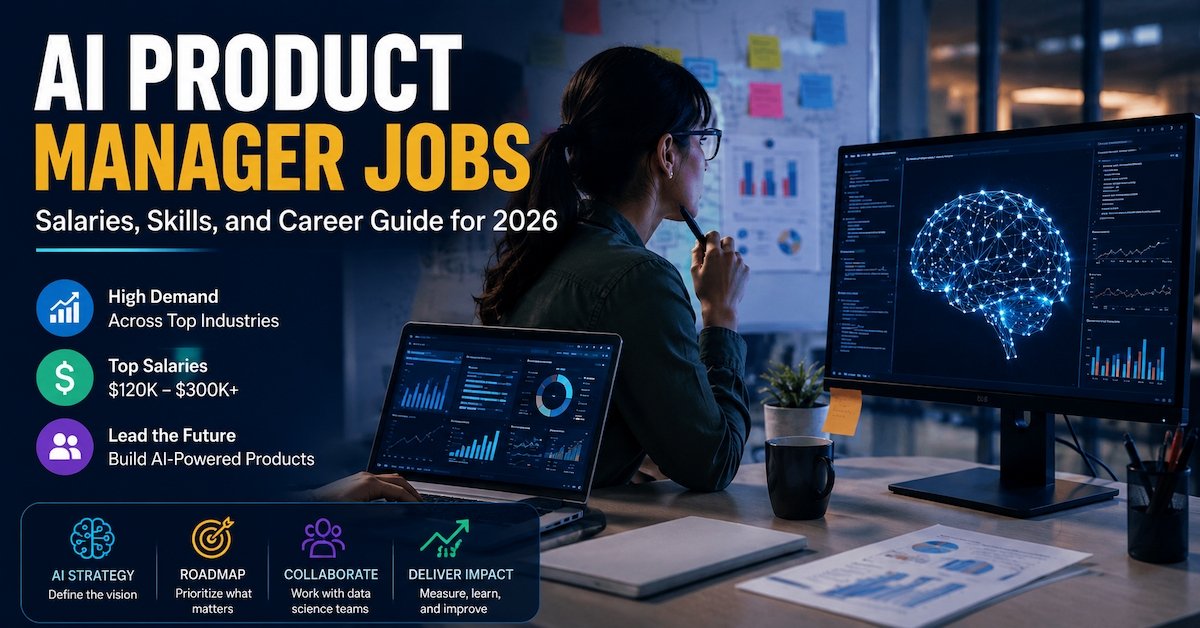
AI product manager jobs are roles where a product manager leads the strategy, roadmap, and launch of products built around artificial intelligence or machine learning. In 2026, US salaries typically range from $120,000 for entry-level roles to over $300,000 total compensation for senior positions, with demand highest in technology, finance, healthcare, and retail. The role differs from traditional product management because it deals with probabilistic systems, models that behave differently as data and usage change over time.
Why AI Product Manager Jobs Are Growing So Fast
Two years ago, this job title barely existed at most companies. Now it is one of the most active hiring categories in tech.
That shift is not hype. Companies are shipping AI features into real products, not just running pilots. Someone has to own the roadmap for those features, decide what "good enough" means for a model, and explain tradeoffs to leadership in plain language. That is the job.
AI product manager jobs sit at the intersection of product strategy and applied AI. You do not need to build the model yourself, but you do need to understand what it can and cannot do well enough to make smart product decisions.
Key Takeaway: AI product manager jobs exist because AI features behave differently than normal software features. Someone with both product judgment and technical fluency has to manage that difference.
What Is an AI Product Manager
Definition: An AI product manager is a product professional who leads the strategy, roadmap, and delivery of products that use artificial intelligence or machine learning. This includes deciding which AI use cases are worth building, working with data science and engineering teams, and defining how success is measured when a product's behavior can shift as models are retrained or updated.
This is different from a traditional product manager role in one key way. A normal software feature behaves the same way every time, unless someone changes the code. An AI feature can behave differently over time, even without a code change, because the underlying model or data has shifted. That difference changes how you plan, test, and communicate about the product.
AI Product Manager vs Traditional Product Manager
Both roles share a lot of overlap. Both own the roadmap, talk to customers, and work closely with engineering. The differences show up in a few specific areas.
| Factor | Product Manager (Traditional) | AI Product Manager |
|---|---|---|
| Core focus | Deterministic features and user flows | Probabilistic model behavior and outputs |
| Success metrics | Usage, conversion, retention | Usage, retention, plus model accuracy and drift |
| Key technical fluency | Basic understanding of engineering | Understanding of ML concepts, training data, evaluation |
| Risk profile | Feature bugs, usability issues | Model errors, bias, unpredictable outputs |
| Common background | Business, design, or engineering | Similar backgrounds, often with added data literacy |
Best Practice: If you are moving from traditional product management into AI product manager jobs, focus first on learning how to read model evaluation metrics. You do not need to build models, but you do need to understand what the numbers mean.
What AI Product Managers Actually Do Day to Day
The title sounds technical, but a lot of the daily work still looks like standard product management. Typical responsibilities include:
- Defining the product vision for how AI fits into the company's broader goals.
- Prioritizing the roadmap based on which AI use cases create real business value.
- Working with data science and engineering teams to scope what is realistically buildable.
- Setting evaluation criteria for when a model's output counts as "good enough" to ship.
- Communicating tradeoffs to leadership, especially around accuracy, cost, and speed.
- Monitoring performance after launch, since AI products can drift and need ongoing review.
Key Takeaway: Much of the job is still classic product management. The difference is that AI product manager jobs require extra fluency in how models are trained, evaluated, and monitored after launch.
AI Product Manager Salary in 2026
Salary data for AI product manager jobs varies a lot depending on the source, company stage, and how a specific employer defines the role. Here is a general range based on multiple industry sources.
- Entry-level roles typically start around $100,000 to $130,000 in the US.
- Mid-level roles generally fall between $130,000 and $180,000.
- Senior roles often reach $180,000 to over $300,000 in total compensation, including equity and bonus at larger or AI-native companies.
- Startup compensation tends to run slightly lower on base salary but can include significant equity upside.
Definition: Total compensation includes base salary plus additional pay like bonuses, stock options, or equity grants. For senior AI product manager jobs, especially at AI-native companies, equity can make up a large share of the total package.
The wide range exists partly because "AI product manager" currently covers two different jobs under one title. Some AI PMs work on core model development and evaluation. Others work on AI features layered onto an existing product. The first type usually commands higher pay, since the technical bar and risk of a bad decision are both higher.
Best Practice: When comparing salary data across sources, check whether the numbers reflect core model-focused AI PM roles or applied AI feature roles. Mixing the two skews the average in either direction.
Skills That Matter Most for AI Product Manager Jobs
Not every skill carries equal weight when it comes to landing the role or earning a higher salary. Based on current hiring trends, these skills tend to matter most.
Technical Skills
- Machine learning fluency. You do not need to code models, but you need to understand training pipelines, evaluation metrics, and common failure modes.
- Data literacy. Basic SQL and comfort reading data are common expectations, even without a data science background.
- Familiarity with product tools. Jira, Confluence, Figma, and similar tools remain standard across most product roles, AI or not.
Product and Strategy Skills
- Framing ambiguous problems. AI use cases often start vague. Turning them into a clear, buildable plan is a core skill.
- Stakeholder communication. Translating model tradeoffs into language executives and customers understand matters as much as the technical knowledge itself.
- Risk assessment. Knowing when an AI feature's error rate is acceptable, and when it is not, is a judgment call AI product managers make constantly.
Key Takeaway: The strongest AI product manager candidates combine real product judgment with enough technical fluency to work directly with data science teams, not just manage them from a distance.
Where AI Product Manager Jobs Are Hiring
Demand for AI product manager jobs spans several industries, though some are hiring faster than others right now.
- Technology companies, including both AI-native startups and established software firms, remain the largest source of openings.
- Finance, where AI is used for fraud detection, risk scoring, and personalized services.
- Healthcare, applying AI to diagnostics, administrative automation, and patient-facing tools.
- Retail and ecommerce, using AI for personalization, demand forecasting, and customer service automation.
- Automotive, particularly around AI-assisted features and autonomous systems.
Manager-level roles currently make up a large share of postings in this category, which signals a market built more around ownership of a product area than entry-level support roles.
Best Practice: If you are early in your career, look for roles at companies where AI is a core part of the product, not just an add-on feature. Owning something with a real AI component builds stronger, more relevant experience than working adjacent to it.
How to Break Into AI Product Manager Jobs
Follow these steps if you are transitioning from a different role or starting your product career focused on AI.
- Build baseline product management experience. AI product manager jobs are rarely a first product role. Most postings expect two or more years of general PM or related technical experience.
- Learn core machine learning concepts. You do not need a data science degree, but understanding how models are trained and evaluated is essential.
- Get hands-on with real AI tools. Working directly with AI products, even side projects, builds credibility beyond reading about the topic.
- Practice explaining model tradeoffs simply. Interviewers often test whether you can translate technical concepts for a non-technical audience.
- Target companies where AI is core to the product. This gives you more direct ownership than an AI feature bolted onto an existing product.
- Prepare for technical interview rounds. Expect questions on evaluation metrics, prioritization under uncertainty, and how you would handle a model that behaves unpredictably in production.
Best Practice: A certification is not required for most AI product manager jobs. Hiring managers generally weigh hands-on experience with real AI products more heavily than credentials alone.
Real Example: A Product Manager Moving Into an AI Role
A mid-level product manager working on a traditional SaaS analytics dashboard might make the shift like this:
- Volunteer to lead a small AI feature already on the roadmap, like an automated insight summary, even if it is not the biggest project on the team.
- Spend time learning how the team's data scientists evaluate model output, including what metrics they track and why.
- Document the tradeoffs made during that project, like accuracy versus response speed, and use that experience directly in later job interviews.
- Apply first to AI feature roles at companies with an established product, before targeting core model-focused AI PM roles that usually require deeper technical depth.
This kind of gradual, project-based transition tends to build more credible experience than switching titles without any hands-on AI work behind it.
Two Types of AI Product Manager Jobs You Should Know About
One reason salary and job descriptions vary so much under this title is that "AI product manager" actually covers two fairly different jobs.
Core Model-Focused AI Product Manager
This version of the role works closely with the actual model development process. Responsibilities often include:
- Defining training data requirements alongside data science teams
- Setting and reviewing model evaluation benchmarks
- Making tradeoff decisions between accuracy, latency, and cost
- Working directly with ML engineers on model iteration cycles
This type of role usually requires deeper technical fluency and tends to pay at the higher end of the salary range, since the technical bar and the cost of a bad decision are both higher.
Applied AI Feature Product Manager
This version of the role focuses on building AI-powered features into an existing product, without owning the underlying model work directly. Responsibilities often include:
- Identifying where an AI feature adds real value to an existing product
- Working with a vendor's or internal team's existing model rather than training one from scratch
- Defining how the feature is tested and rolled out to users
- Measuring feature adoption and user trust over time
This version of the role is more accessible to product managers moving over from traditional software roles, since it leans more on product judgment than deep ML expertise.
Key Takeaway: Knowing which type of AI product manager job you are applying for helps you prepare the right skills and set realistic salary expectations. The two roles are not interchangeable, even though they share a title.
Interview Preparation for AI Product Manager Jobs
Interviews for this role typically go beyond standard product management questions. Expect a mix of the following:
- Product sense questions, similar to traditional PM interviews, focused on prioritization and user needs.
- Technical fluency checks, where you may be asked to explain how you would evaluate whether a model is ready to ship.
- Case studies involving ambiguity, since AI use cases often start without a clear, proven path to build.
- Metrics and evaluation questions, testing whether you understand concepts like precision, recall, or model drift at a working level.
- Communication exercises, where you explain a technical tradeoff to a non-technical stakeholder in the room.
Best Practice: Prepare one or two real examples where you made a product decision involving uncertainty or incomplete data. AI product manager interviews often probe for judgment under ambiguity more than they probe for pure technical knowledge.
AI Product Manager Certifications and Training
A common question from career changers is whether a certification is necessary to break into AI product manager jobs. In most cases, it is not required, but structured learning can still help close specific skill gaps.
- Online courses from platforms like Coursera or Udemy can build foundational ML literacy for non-technical candidates.
- Bootcamps focused on AI product management can offer structured project work, which is useful for building a portfolio.
- Hands-on side projects often carry more weight with hiring managers than a certificate alone, since they show applied skill rather than passive learning.
The strongest candidates typically combine some structured learning with real project experience, rather than relying on either one alone.
Where to Search for AI Product Manager Jobs
Beyond general job boards, a few platforms tend to surface AI-focused product roles more consistently:
- Company career pages at AI-native companies, since many post roles there before general job boards.
- LinkedIn Jobs, using specific search terms like "AI product manager" plus your target industry.
- Specialized tech recruiters, who often work directly with startups filling AI-specific roles.
- AI and product management communities, where openings sometimes get shared before wider public postings.
Best Practice: Search using both broad and specific terms. "AI product manager," "machine learning product manager," and "applied AI product manager" can surface different, sometimes non-overlapping, sets of job postings.
Common Mistakes Job Seekers Make With AI Product Manager Jobs
- Applying without any hands-on AI experience. Reading about AI is not the same as having shipped something with a real model component.
- Overselling technical depth. Claiming deep ML expertise without backing it up in an interview tends to backfire quickly.
- Ignoring the two different job types. Core model-focused roles and applied AI feature roles expect different skills and pay differently. Target the right one for your background.
- Skipping salary research by company stage. Startup compensation and large public company compensation can look very different, even for similar titles.
- Underestimating communication skills. Technical fluency matters, but the ability to explain tradeoffs clearly to non-technical stakeholders is just as important in most AI product manager jobs.
Frequently Asked Questions
US salaries generally range from $120,000 at entry level to over $300,000 in total compensation for senior roles, depending on company stage and role type.
Not always. Many AI product managers come from non-technical backgrounds and build data literacy and ML fluency through hands-on experience or targeted learning.
Yes. Demand is growing quickly across technology, finance, healthcare, and retail, with the role expected to keep expanding through the rest of the decade.
A data scientist builds and tests models. An AI product manager decides what to build, sets priorities, and translates model behavior into product and business decisions.
Yes. Many AI product managers started in traditional PM roles and transitioned by building ML literacy and taking on AI-focused projects.
Final Thoughts
AI product manager jobs sit at the center of one of the fastest-growing hiring categories in tech right now. The role rewards people who can combine solid product judgment with enough technical understanding to work closely with data science teams. If you are considering this path, start by building real, hands-on experience with AI features, learn how model evaluation works, and target roles that match your current technical depth honestly.
If you are exploring more career and hiring trends in AI, see our guide on top AI consulting firms, or check out our piece on Abraham Quiros Villalba's perspective on AI tools for a broader look at how AI is reshaping tech careers.
For more detail on how AI product manager compensation is structured in 2026, see Glassdoor's AI product manager salary data.