Quick Answer
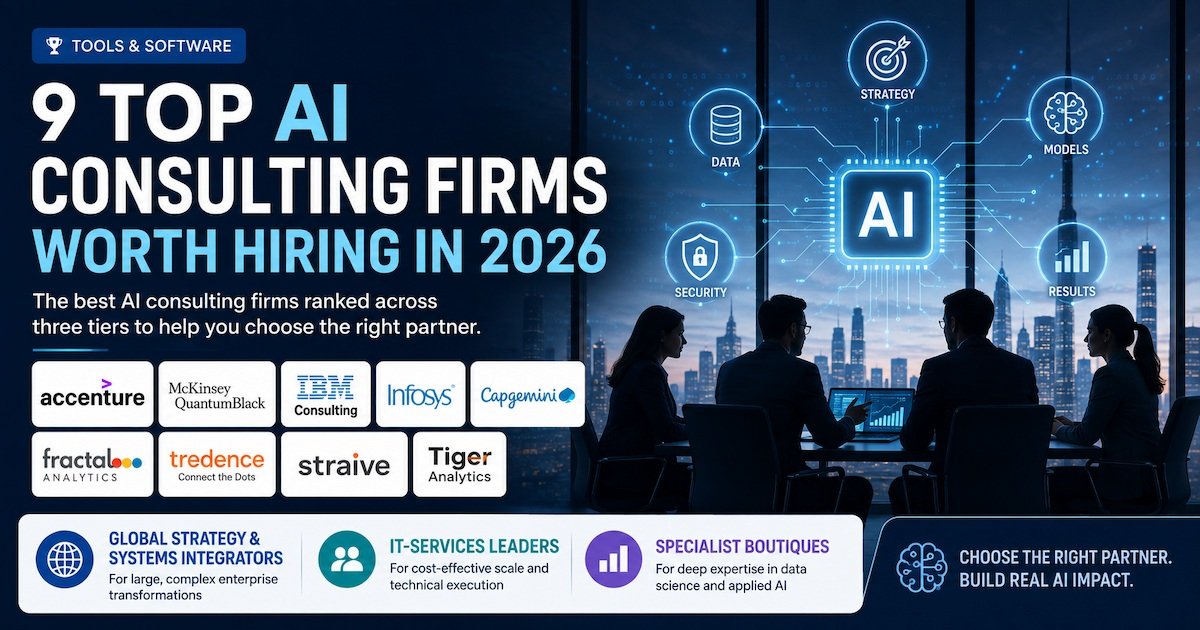
Top AI consulting firms in 2026 fall into three groups. Global majors like Accenture, McKinsey's QuantumBlack, and IBM Consulting handle large enterprise transformations. IT-services leaders like Infosys, TCS, and Capgemini offer cost-effective scale for mid-size and large companies. Specialist boutiques like Fractal Analytics and Tredence focus deeply on data science and applied AI. The right firm depends on your budget, industry, and how far along you already are with AI.
Why So Many Companies Are Hiring AI Consultants Right Now
AI stopped being a side project a while back. Most companies now treat it as something that has to actually work, not just something to test in a lab.
That shift is why top AI consulting firms are busier than ever. Building a working AI system takes more than a good idea. It takes clean data, the right architecture, security review, and a team that has done this before. Most internal IT teams have not done it enough times to move fast without expensive mistakes.
This guide breaks down the top AI consulting companies for 2026, what each one actually does well, and how to figure out which type of firm fits your situation.
Key Takeaway: The best AI consulting firm is not always the biggest name. It is the firm whose size, industry experience, and pricing model actually match your project.
What Is an AI Consulting Firm
Definition: An AI consulting firm is a company that helps businesses plan, build, and deploy artificial intelligence systems. This usually includes evaluating where AI fits the business, checking if the company's data is ready, choosing the right technical approach, and managing the rollout so the system actually gets used, not just built and forgotten.
Most AI consulting firms offer some combination of the following services:
- AI strategy and use case discovery
- Data readiness and infrastructure assessment
- Model development and integration
- Deployment, security, and governance
- Change management and staff training
Some firms cover the entire journey from strategy to deployment. Others specialize in just one piece, like data engineering or model development.
The Three Tiers of Top AI Consulting Companies
Not every AI consulting firm serves the same kind of client. It helps to think of the market in three tiers.
1. Global Strategy and Systems Integrators
This tier includes firms like Accenture, McKinsey's QuantumBlack, BCG X, Deloitte, IBM Consulting, PwC, and EY. These are the top ai consulting company names most executives already recognize. They handle large, complex transformations across multiple business units, often for Fortune 500 companies.
Best for: Large enterprises with big budgets and complex, multi-year AI programs.
2. IT-Services Leaders
This tier includes firms like Infosys, TCS, Capgemini, and Wipro. They offer strong technical delivery at a lower cost than the global strategy firms, often through large offshore or hybrid delivery teams. Many businesses searching for the best ai consulting firms in it services land here specifically because of the cost-to-scale ratio.
Best for: Mid-size to large companies that want strong technical execution without paying premium strategy-firm rates.
3. Specialist Boutiques
This tier includes firms like Fractal Analytics, Tredence, Tiger Analytics, and Straive. These firms tend to go deep on data science, applied AI, and specific industries, like financial services, life sciences, or retail, rather than covering every possible business function.
Best for: Companies that want deep expertise in a specific AI use case or industry, without the overhead of a global systems integrator.
Best Practice: Match the tier to your project size. A small, focused AI pilot rarely needs a global strategy firm, and a company-wide AI transformation rarely fits well inside a small boutique's capacity.
9 Top AI Consulting Firms in 2026
Pricing and service scope change often, so confirm current details directly with each firm before committing to a project.
1. Accenture
Accenture is one of the largest technology consulting firms in the world, with a deep AI practice spanning strategy, engineering, and managed services. It is often the default choice for large-scale, multi-year enterprise AI transformations.
Best for: Very large enterprises running company-wide AI transformation programs.
Pros:
- Massive delivery scale across industries and regions
- Deep partnerships with major cloud and AI platform providers
- Can handle strategy through long-term managed services
Cons:
- Premium pricing compared to smaller firms
- Can feel slow-moving for smaller, fast-turnaround projects
2. McKinsey (QuantumBlack)
QuantumBlack is McKinsey's dedicated AI and analytics arm. It combines McKinsey's strategy pedigree with hands-on AI engineering, which appeals to executives who want both boardroom-level advice and technical delivery from the same partner.
Best for: Companies that want AI strategy tied directly to broader business strategy work.
Pros:
- Strong executive-level strategic framing
- Deep bench of data scientists and engineers
- Well-suited to high-stakes, high-visibility AI initiatives
Cons:
- One of the more expensive options in the market
- Engagements often require significant internal stakeholder time
3. IBM Consulting
IBM Consulting has one of the longest track records in enterprise AI, particularly in regulated industries like finance, healthcare, and manufacturing. It focuses on fitting AI into existing systems rather than replacing them outright.
Best for: Enterprises in regulated industries that need AI to work within strict compliance requirements.
Pros:
- Long history working with large, complex IT environments
- Strong focus on security and regulatory fit
- Broad experience across generative AI, automation, and LLM architecture
Cons:
- Can be slower to adopt newer, more experimental approaches
- Better suited to established enterprises than fast-moving startups
4. Infosys
Infosys is one of the top ai consulting firms in it services sector, known for large-scale technical delivery at a competitive price point. It combines AI consulting with the broader IT outsourcing capabilities the company has built over decades.
Best for: Companies that want strong technical execution at a lower cost than global strategy firms.
Pros:
- Cost-effective delivery at scale
- Broad experience across industries and geographies
- Strong existing relationships with enterprise IT departments
Cons:
- Less focused on high-level strategy compared to MBB-style firms
- Quality can vary depending on the specific delivery team assigned
5. Capgemini
Capgemini blends AI consulting with strong cloud and data engineering capabilities. It has built a reputation for helping large companies modernize legacy systems while layering in AI capabilities, rather than treating AI as a separate project.
Best for: Companies that need AI work tied closely to broader digital transformation and legacy modernization.
Pros:
- Strong data engineering and cloud integration experience
- Good fit for companies with significant legacy technical debt
- Global delivery footprint
Cons:
- Best suited to larger, longer-term engagements
- Less specialized than boutique AI-only firms
6. Fractal Analytics
Fractal Analytics focuses specifically on decision science and applied AI, helping large enterprises build analytics and AI products across functions like marketing, supply chain, and risk. It frequently supports multi-year data science partnerships with Fortune 500 companies.
Best for: Enterprises that want deep, specialized data science expertise rather than broad general consulting.
Pros:
- Strong specialization in applied AI and decision science
- Track record with large, well-known enterprise clients
- Focused delivery rather than spread across too many service lines
Cons:
- Narrower scope than full-service systems integrators
- Best fit is data-heavy use cases, not broad IT transformation
7. Tredence
Tredence is a data and AI consulting firm known for practical, use-case-driven engagements. It tends to focus on specific business outcomes, like improving supply chain forecasting or customer analytics, rather than broad, open-ended strategy work.
Best for: Companies that want a clear, outcome-focused AI project rather than a long strategic engagement.
Pros:
- Practical, outcome-oriented approach
- Strong technical delivery on specific use cases
- Often faster time-to-value than larger strategy firms
Cons:
- Less suited to enterprise-wide, multi-year transformation programs
- Smaller global footprint than the largest systems integrators
8. Straive
Straive is a data and AI services firm built around the idea that AI only performs well on clean, well-governed data. It works across the full lifecycle, from data readiness through model deployment and ongoing AI operations, and includes structured support for moving AI projects from pilot to production.
Best for: Companies in regulated or content-heavy industries that need strong data governance built into their AI work.
Pros:
- Strong focus on data quality and governance from the start
- Full lifecycle support, not just strategy or just delivery
- Deep experience in publishing, financial services, and life sciences
Cons:
- More specialized in data-heavy AI programs than general strategy work
- Less recognized name compared to global majors, despite strong delivery
9. Tiger Analytics
Tiger Analytics is another specialist firm focused on applied data science and AI, often working alongside a company's internal teams rather than fully replacing them. It tends to emphasize practical deployment over theoretical strategy decks.
Best for: Companies that want a collaborative partner to work alongside an existing internal data team.
Pros:
- Collaborative delivery style that builds internal capability
- Strong technical depth in applied AI and analytics
- Flexible engagement models compared to rigid enterprise contracts
Cons:
- Smaller scale than the largest global integrators
- Better suited to focused projects than sprawling enterprise transformations
Best Practice: Ask any firm you are evaluating for two or three reference clients in your specific industry. A firm's general reputation matters less than its track record with companies that look like yours.
Comparison Table: Top AI Consulting Firms
| Firm | Tier | Main Strength | Best For |
|---|---|---|---|
| Accenture | Global integrator | Massive scale delivery | Company-wide transformation |
| McKinsey (QuantumBlack) | Global strategy | Strategy plus engineering | High-stakes strategic initiatives |
| IBM Consulting | Global integrator | Regulated industry fit | Finance, healthcare, manufacturing |
| Infosys | IT-services leader | Cost-effective scale | Budget-conscious technical delivery |
| Capgemini | IT-services leader | Cloud and legacy modernization | Digital transformation plus AI |
| Fractal Analytics | Specialist boutique | Decision science depth | Data-heavy enterprise use cases |
| Tredence | Specialist boutique | Outcome-driven delivery | Focused, specific AI projects |
| Straive | Specialist boutique | Data governance and lifecycle | Regulated, content-heavy industries |
| Tiger Analytics | Specialist boutique | Collaborative delivery | Teams building internal AI capability |
How Much Does AI Consulting Cost
AI consulting pricing varies widely based on scope and firm tier. As a general guide:
- Small discovery or prototype projects typically start around $10,000 to $50,000.
- Focused implementation projects often fall in a similar range, depending on complexity.
- Large, complex builds involving custom models, enterprise integration, and governance can reach six figures or more.
- Global strategy firms generally sit at the higher end of pricing, while IT-services firms and boutiques tend to offer more competitive rates for similar scopes.
Key Takeaway: Price alone does not indicate quality. A lower-cost IT-services firm can deliver excellent technical work, while an expensive global firm may be the wrong fit for a narrow, technical project.
How to Choose the Right AI Consulting Firm
Follow these steps to narrow the field instead of defaulting to the most recognizable name.
- Define your project scope first. A single use case needs a different partner than a company-wide transformation.
- Match the firm's tier to your budget. Global strategy firms cost more than IT-services leaders or boutiques for similar technical work.
- Check industry experience. A firm with deep healthcare or finance experience will move faster in those industries than a generalist.
- Ask about data governance. Confirm how the firm handles data security, especially if your industry has strict compliance requirements.
- Review real client references. Ask for examples of projects similar in size and industry to yours, not just general case studies.
- Clarify the handoff plan. Make sure the engagement includes a clear plan for your internal team to maintain the system after the consultants leave.
Best Practice: Start with a smaller, well-defined pilot project before committing to a large, multi-year engagement. This lets you evaluate a firm's actual delivery quality before scaling the relationship.
Real Example: How a Mid-Size Company Might Choose a Firm
A mid-size logistics company wanting to improve delivery forecasting with AI might approach the decision like this:
- Rule out the largest global strategy firms early, since the project is focused and does not need company-wide transformation consulting.
- Shortlist two or three specialist boutiques, like Tredence or Fractal Analytics, that have direct experience in supply chain and logistics use cases.
- Request references from each firm for a similar forecasting project, and check in directly with those reference clients.
- Start with a small pilot project, limited to one region or product line, before agreeing to a larger, company-wide rollout.
This kind of scoped, reference-checked approach usually produces a better outcome than choosing a firm based on brand recognition alone.
AI Consulting vs Building an In-House Team
Some companies debate whether to hire one of the top ai consulting companies or build an internal AI team instead. Both paths make sense in different situations.
| Factor | Hiring an AI Consulting Firm | Building an In-House Team |
|---|---|---|
| Speed to start | Fast, existing expertise ready to deploy | Slower, requires hiring and onboarding |
| Cost structure | Project-based or retainer fees | Ongoing salaries and benefits |
| Long-term knowledge | Can leave with the consultants unless handoff is planned | Stays within the company |
| Best fit | Focused projects or unfamiliar technical territory | Ongoing, core AI capability the business depends on long-term |
| Flexibility | Easy to scale up or down per project | Harder to scale quickly without new hires |
Many companies use a hybrid approach. They bring in a top ai consulting firm for the first project or two, while training internal staff alongside the consultants. Over time, the internal team takes on more of the work directly.
Key Takeaway: Consulting firms are often the fastest way to start an AI project, but a clear plan to build internal capability prevents long-term dependence on outside help.
Signs Your Company Is Ready to Hire an AI Consulting Firm
Not every company needs outside help immediately. These signs suggest it might be time to bring in a consulting partner:
- Your team has identified a clear AI use case but lacks the technical expertise to build it
- Data quality or governance issues are blocking progress on an AI initiative
- Leadership wants a structured AI strategy but no one internally has done this before
- A previous internal AI pilot stalled and did not reach production
- Compliance or security requirements demand experience your team does not have
Best Practice: Before reaching out to any firm, write down your specific goal in one sentence. A consulting engagement without a clear goal tends to drift and cost more than expected.
Common Mistakes Companies Make When Hiring AI Consultants
- Choosing based on brand name alone. The most recognizable firm is not always the best fit for a specific project size or industry.
- Skipping the data readiness check. AI projects fail more often from poor data quality than from bad model choices.
- Signing a large contract before a pilot. A small pilot project reveals a firm's real delivery quality before you commit significant budget.
- Ignoring the handoff plan. Without a clear plan to transfer knowledge to your internal team, you can end up dependent on the consulting firm indefinitely.
- Underestimating governance needs. Regulated industries need firms with strong compliance and security track records, not just strong technical skills.
Frequently Asked Questions
Final Thoughts
The top AI consulting firms in 2026 span three very different tiers, global strategy giants, IT-services leaders, and specialist boutiques. The right choice depends on your project size, budget, and industry, not just brand recognition. Start with a clearly scoped pilot, check real references, and make sure any firm you choose has a plan to leave your internal team capable of maintaining the system long after the engagement ends.
If you are exploring more AI tools and services for your business, see our guide on AI powered chatbot platforms, or check out our roundup of top SaaS tools for startups for the broader software stack that often works alongside AI consulting engagements.
For more on how global IT spending is shifting toward AI, see Gartner's forecast on worldwide IT spending.